
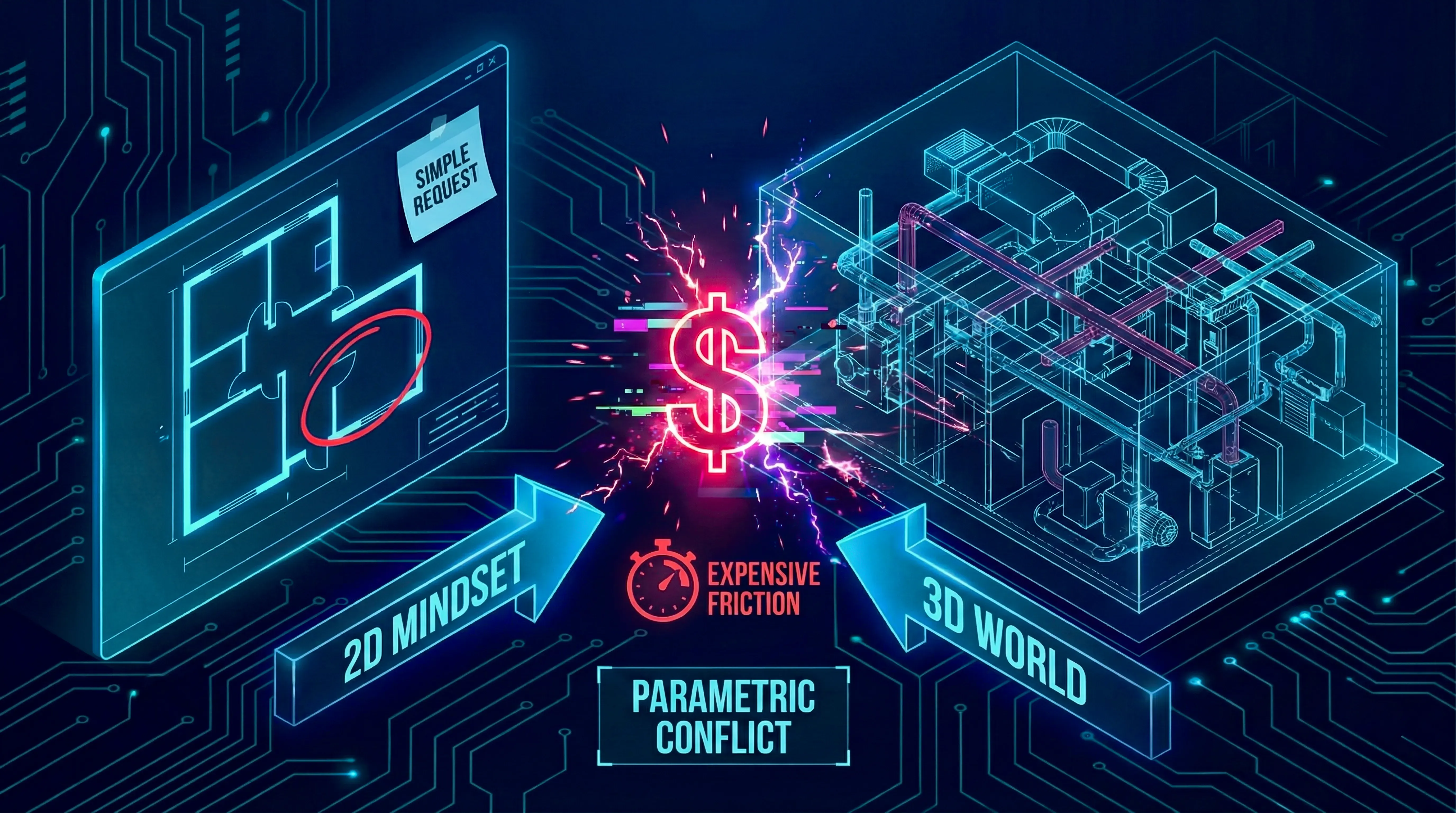
The 2D Mindset in a 3D World: When ‘Simple’ Requests Become Expensive
The friction between 2D thinking and 3D parametric modelling, and why small late-stage changes in BIM often trigger cascading coordination consequences.
A Familiar Problem, in a New Interface
Most BIM teams don’t break because the model is difficult.
They break because the conversation around the model is difficult.
There’s a specific kind of friction that shows up on projects with mixed workflows, strong 2D leadership, and a fast-moving client: people are looking at a 3D model, but thinking in 2D. The moment pressure rises, the model gets treated like a drawing that happens to rotate.
That’s when the project slowly turns into a cycle of duct-taped solutions.
What People Mean When They Say “Just Modify It”
A 2D drawing is the representation of the design.
A BIM model is the data-rich, interconnected reality of the design.
So when someone asks for “minor modifications,” they’re often describing something that appears visually small in AutoCAD, but structurally large inside a parametric system. Hosting breaks. Constraints collapse. Clearances fail. Sheets get reissued. Coordination debt accumulates.
From the individual’s perspective, the request looks harmless.
The consequences aren’t.
First Observation: “Can’t You Just Delete the Finish?”
One of the clearest examples was a conversation with a 2D draftsman:
“Can you remove your finish layer from the ID model? We’ll keep the architectural plaster finish.”
In a 2D workflow, that makes perfect sense. Delete the hatch. Keep the wall. Everyone goes home. This scenario perfectly highlights the gap between aesthetic design intent and engineering reality.
In a BIM environment, that finish wasn’t just decoration; it was a host element.
Joinery components were attached to it. Families were face-hosted to it. Parametric logic depended on it. Removing that layer meant more than deleting a surface; it meant dismantling a network of relationships used to coordinate multiple disciplines.
The result was predictable: hours of back-and-forth trying to explain that “deleting a layer” does not map to “deleting a model element” when that element is the anchor for everything else.
This wasn’t simply a communication error.
It was a conceptual mismatch between representation and parametric dependency.
Second Observation: Late Changes That Aren’t Really “Changes”
A fast-paced luxury high-rise project exposes this disconnect brutally.
Late in DD or CD, a client may request what sounds like a minor adjustment, shift a ceiling, move a wall, tweak a layout, because the change appears small in a view.
But towers don’t behave like that.
A ceiling change isn’t a ceiling change. It’s a chain reaction:
- Rerouted ducts and cable trays.
- Slopes recalculated.
- Access and clearance rechecked.
- Penetrations realigned.
- Drawings and tags reissued.
At that stage, you don’t “edit.”
You re-coordinate.
In parametric modelling, elements aren’t isolated lines. They are data-linked objects. Moving a wall late in the project doesn’t just shift geometry; it forces updates to room tags, area schedules, MEP terminal hosts, and structural interfaces.
So the project enters a loop: the team is asked to move fast, but the model demands correctness. And correctness takes time when systems are interconnected, often forcing coordinators into an exhausting cycle of context shifting as they abandon planned tasks to trace these ripple effects.
Third Observation: Where Revizto Helps, and Where It Quietly Misleads
Revizto is genuinely useful. It brings stakeholders into a shared review space, combines 2D and 3D views, and anchors discussions to real locations and issues. Used properly, it reduces uncertainty and shortens coordination cycles.
But it also creates a subtle illusion:
“If I can see it, I understand it.”
That’s not always true.
Revizto’s game like maneuverability improves the interface. It does not automatically teach hosting logic, clearance constraints, or downstream impacts. Some teams fall into what I call The Revizto Trap: the tool makes coordination look easy, and that appearance gets mistaken for actual effort.
The phrasing changes, but the logic remains:
“It’s digital. It should be quick.”
Why Late Changes Hurt
There’s a reason so many BIM delivery discussions revolve around shifting effort earlier, from Design Proposal to Schematic Design to Detailed Design.
The idea, often illustrated by the MacLeamy Curve, is straightforward: the later you are in the project lifecycle, the more expensive and disruptive change becomes, because more work is already connected to what you’re modifying.
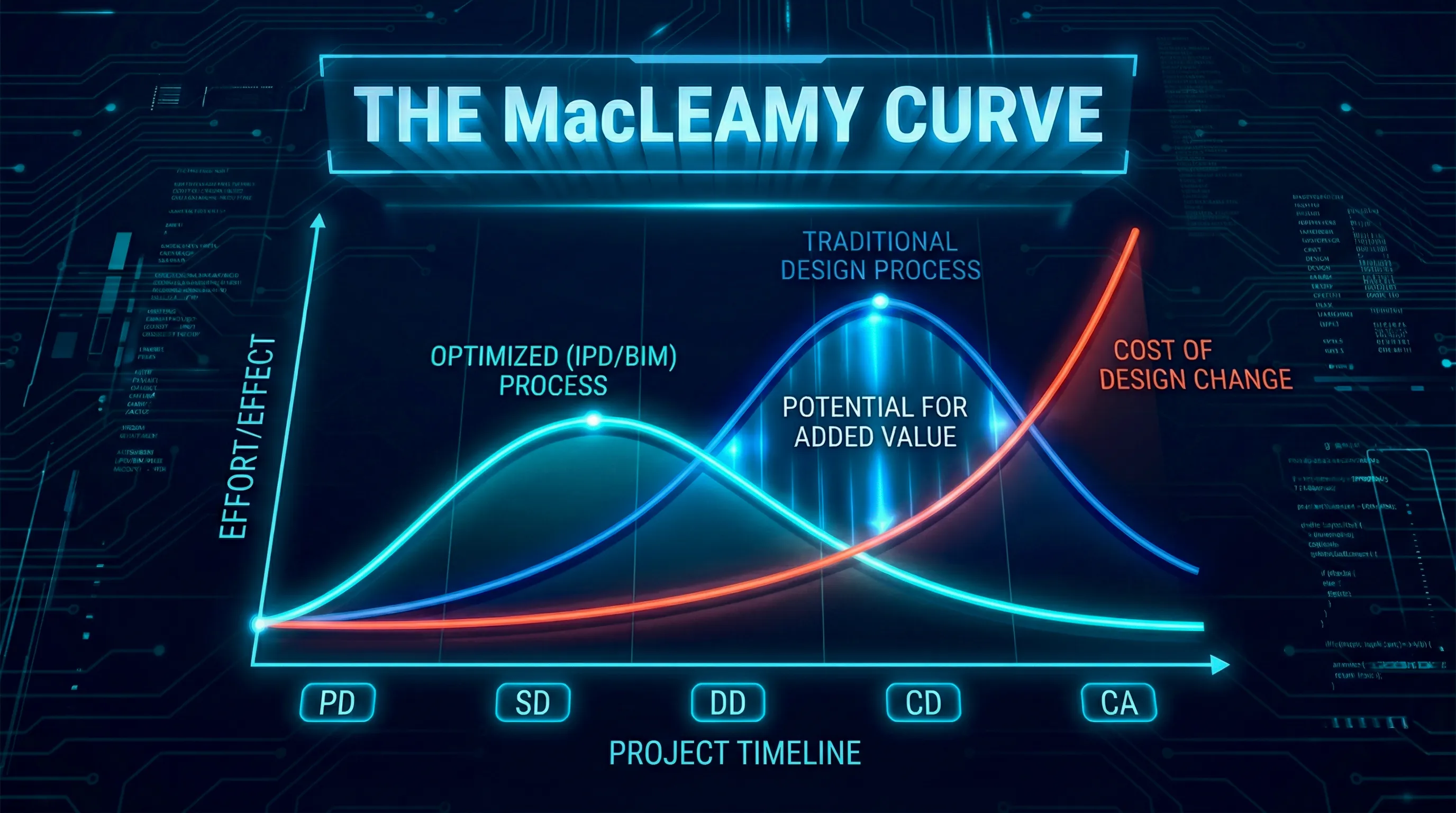
In plain terms:
A late change isn’t just a task.
It’s a task plus the repair of everything it disrupts.
Proposed Solution: Eliminating the Coordination Gap Through Radical Visibility
This problem isn’t solved by asking everyone to “learn BIM.”
That’s not realistic.
It is solved by institutionalizing transparency that forces impact to be acknowledged before decisions are made.
International standards (like ISO 19650) provide a shared rulebook for how project information is handled. Having a BIM Execution Plan isn’t about creating extra paperwork; it’s an insurance policy. It ensures that decisions are based on verified facts rather than ‘best guesses,’ protecting the project from the expensive mistakes that happen when people assume they are on the same page.
A practical complement is an explicit LOD framework, clarifying what model elements represent and what they can be relied upon for at each stage.
LOD Reference Table
| Stage | LOD | Geometric Representation | Reliability | Authorized Uses |
|---|---|---|---|---|
| Concept | 100 | Generic shapes, lines, symbols | Low / Visual Only | Spatial layout, massing studies |
| Schematic | 200 | Placeholder families, approximate size | Medium / Tentative | Initial coordination, system intent |
| Detailed Design | 300 | Accurate size, shape, orientation | High / Baseline | Clash detection, quantity take-offs |
| Construction | 350 | Objects with hosts and physical connections | Critical / Host-Ready | Shop drawings, interface management |
| Fabrication | 400 | Full-detail assemblies with fabrication data | Certified | Manufacturing and installation |
Still, the most effective control is simpler than most expect.
The Change Impact Card (A 10-Minute Gate That Saves Weeks)
After mid-DD, requests affecting walls, ceilings, shafts, or primary routing should not arrive as casual messages.
They should be issued as decisions.
Change Impact Card (Template)
Core Details
- ID & Date: _________ | _________
- Requested By: __________________
- Project Stage: [ ] SD | [ ] DD | [ ] CD | [ ] IFC
- Status of Data: [ ] Based on LOD 300+ Verified Data
The Proposed Deviation
- What is changing: _________________________________________
- Driver / Reason: __________________________________________
Impact Assessment (Check all triggered systems)
- Hosting logic & dependencies
- Clearances & maintenance access
- Routing & slope recalibration
- Shafts & structural penetrations
- Ceiling void coordination
- Drawing reissues & tag displacements
Cascading Ripple Preview (Top 3 downstream effects)
- Estimated Re-coordination Man-hours: _______________________
Resolution & Time Classification
- Delay Risk: [ ] A (Same Day) | [ ] B (2-3 Days) | [ ] C (1-2 Weeks) | [ ] D (Milestone Reset)
- Decision: [ ] Approve | [ ] Defer | [ ] Reject | [ ] Replace
- Authorized By: __________________
Now for the Coordinator or BIM Manager, the million dollar question is not how to introduce a new form.
It is how to introduce a pause between an informal design instruction and a coordinated model change.
The Strategy: The “Insurance” Pitch
1. Don’t sell the process (the card); sell the liability protection (the result).
-
To the End Client: “We are implementing a ‘Change Impact Protocol’ to prevent hidden downstream coordination costs. In BIM, a small change in Design Development can trigger several days of re-coordination across multiple sub-consultants. This card ensures the time and labor impact is understood and authorized before the change is absorbed into the model.”
-
To the Lead Consultant: “This protocol protects your design intent from being unintentionally compromised during coordination. Informal instructions can result in geometry that violates structural or MEP requirements. The system allows us to immediately flag these risks before they propagate into drawings or clash-free models.”
2. The Practical Reality: Not All Changes Carry the Same Coordination Liability
Requesting formal documentation for every adjustment will be bypassed in practice.
Instead, deviations must be filtered by their coordination impact.
The “Filter” Rule:
- Minor Moves: (e.g., shifting a door within the same host wall, or adjusting an internal partition without affecting services) = Casual message / Revizto pin.
- Major Shifts: (e.g., changing a wall type, relocating a shaft, lowering a ceiling affecting services clearance, or modifying a hosted system) = Change Impact Card.
For the Change Impact Card to be effective, its use must be triggered systematically, particularly in fast-paced delivery environments where:
- Informal messaging platforms are used for coordination
- Issue tracker pins are interpreted as design instructions
- Verbal discussions are treated as implicit approval
…model geometry may change without a formally documented deviation, only to raise questions weeks later during IFC issuance.
How Revizto Fits (The Right Way)
Revizto becomes powerful when it is used to show impact, not merely log complaints.
Run a short Live Impact Session:
- Section-box the affected zone
- Show hosting relationships
- Show clearance and rerouting consequences
- Log the decision with images and notes
The objective is simple:
Replace “It’s a small change” with
“Here’s what it triggers.”
Closing
This is not an argument for making every stakeholder a modeller.
It is an argument for ending the industry habit of treating parametric models like drawings with better graphics.
When governance and strict quality control discipline are missing, the model becomes a point of negotiation..
When governance exists, the model becomes what it should be: a coordination instrument that protects time, cost, and intent.