
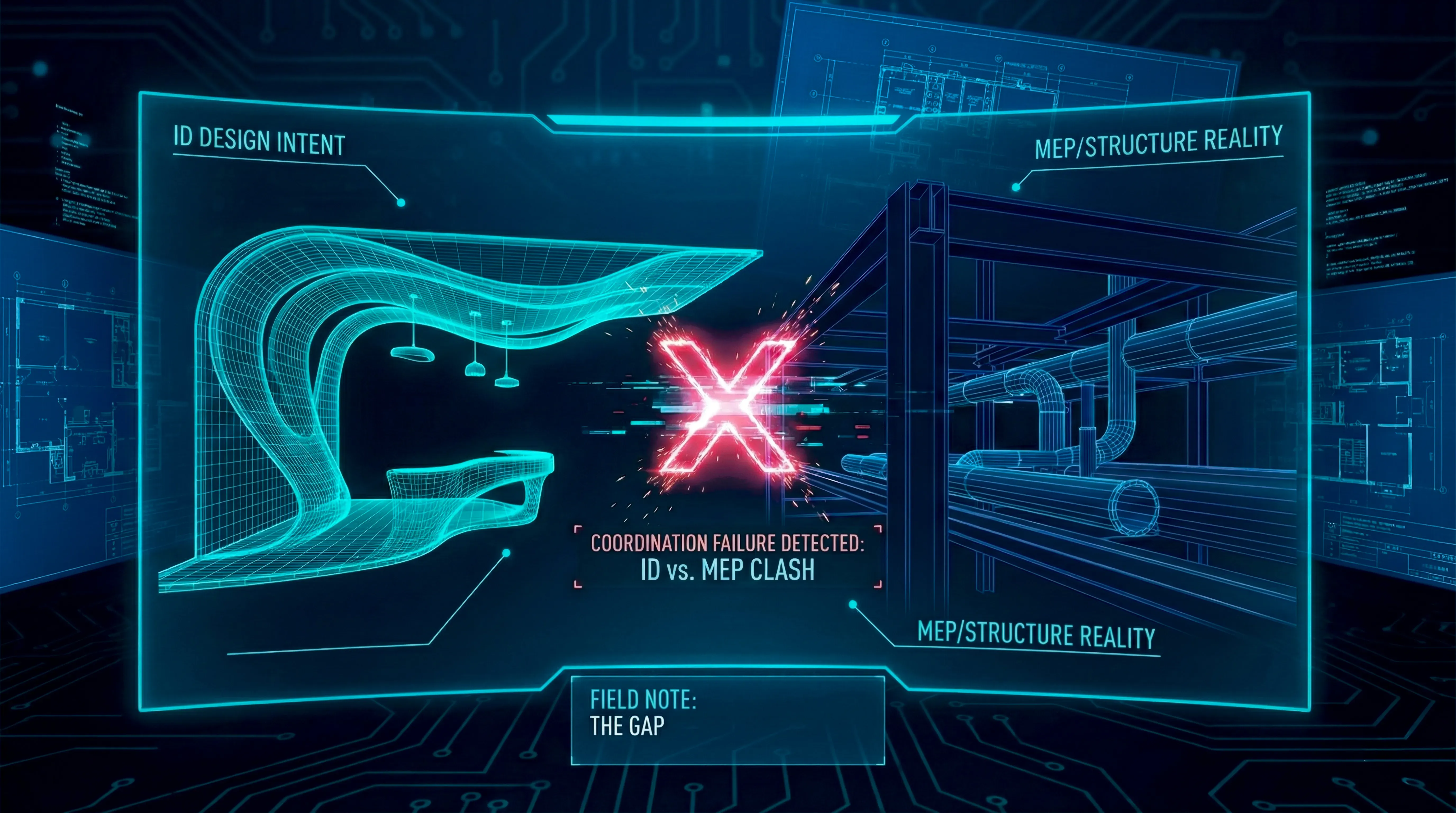
The Gap Between Design Intent and Engineering Reality
The Context
In high-stakes construction environments, one of the most volatile friction points emerges where aesthetic vision meets engineering physics.
A recent coordination meeting between the Contractor, Consultant, and ID Modeling team illustrated a recurring industry challenge:
The ID model was developed to reflect the client’s visual aspirations. However, it is now confronting the hard constraints imposed by mechanical performance requirements and structural safety principles.
The issue was not capability, it was model definition alignment.
Observation 1: The “Invisible” Physics of Airflow
The Scenario
The Interior Design team proposed side-throw air grills concealed within ceiling coves to preserve a clean visual aesthetic.
The Reality
- The cove depth in the ID model was limited to 100 mm.
- The mechanical consultant clarified that a side-throw grill requires a minimum plenum depth of approximately 300 mm to function properly.
The Domino Effect
- Installing the grill inside the shallow cove created clashes with lighting strips.
- The ceiling level would need to be lowered to accommodate mechanical requirements.
- The original aesthetic intent would be compromised.
Field Lesson
Aesthetics cannot override thermodynamics.
Ceiling coves and similar ID features must be treated as functional mechanical zones, not purely decorative elements. A simple 2D section analysis during concept development would have revealed that a 300 mm unit cannot physically operate within a 100 mm void.
Observation 2: The “Fluid Landscape” vs. the Stack Effect
The Scenario
To achieve visual continuity at the Kids Pool entrance, the design team proposed removing doors and smoke shafts to create a fluid spatial transition.
The Reality
- The consultant rejected the proposal, citing the stack effect in high-rise towers.
- Without these doors, pressure differentials (up to 200 Pascals) would compromise smoke control performance.
- The Fire Life Safety strategy would fail.
Field Lesson
Fire strategy is a frozen constraint.
In ID modeling, doors are often treated as removable visual barriers. In reality, they are critical components of the building’s pressurization and life safety system.
These elements must be locked in the model to prevent aesthetic deletions that violate code.
Observation 3: The “Specialty Item” Void
The Scenario
A 1.5 m raised floor (likely a mechanical deck or podium) created a coordination deadlock.
The Reality
- The MEP team could not route ducts because steel support locations were unknown.
- The Structural team declined to model the floor, categorizing it as a “Specialty Item” (Fisher systems).
- The raised floor existed physically, but not in the BIM model.
The result: A clash-free model became impossible because a major structural element was absent from the digital environment.
Field Lesson
If it is not defined in the LOD matrix, it becomes a coordination blocker.
“Contractor-designed” or specialty items frequently fall into modeling ambiguity. As BIM leads, we must introduce space reservation placeholders early to prevent MEP systems from routing through future structural zones.
Absence in the model does not mean absence in reality.
Conclusion: From Visual Model to Constructible Model
The friction observed was not rooted in incompetence. It stemmed from a misalignment in model purpose.
The ID model was answering:
“What does the client want it to look like?”
The consultant was answering:
“How do we ensure this building performs safely and legally?”
Future coordination must shift from modeling appearance to modeling constraints.
By incorporating:
- Plenum clearance logic
- Fire strategy locks
- Structural placeholder zones
- Functional zoning validation
early in the process, coordination clashes can evolve into early-stage design resolutions rather than late-stage conflicts.
The construction process must be the architect of the final aesthetic.